
Agile theater: the most common failure mode
Agile transformations fail predominantly because organizations adopt the ceremonies without the underlying change in how decisions are made. Teams hold daily stand-ups, run Sprints, maintain a board, the events Scrum defines, though almost everyone calls them ceremonies. But priorities still come top-down as fixed annual plans, work still passes through the same approval gates, and “done” still means handed to the next silo. This is Agile theater: the visible rituals of agility performing over an unchanged operating model.
Theater is seductive because it shows activity without demanding hard structural choices. This is why year one always looks like a success: teams form squads, ceremonies happen on schedule, and velocity charts look good. Leadership is enthusiastic, and the kickoff slides look bulletproof. However, the trap is mistaking these fast, visible structural wins for slow, invisible cultural change. It is also self-reinforcing — leaders see the ceremonies and assume the transformation is underway, while teams quietly conclude that nothing real has changed. Recognizing theater for what it, is marks the first honest step toward fixing it.
Agile theater has a close cousin with an older name. A ScrumBut is the pattern of keeping the framework in name while dropping the rule that hurts, and it always has the same three parts: the rule, the reason, and the workaround. “We use Scrum, but retrospectives are a waste of time, so we skip them.” The two fail in opposite directions. A ScrumBut removes a practice and says so out loud; theater keeps all of them and changes nothing underneath. Several of the anti-patterns below are ScrumButs in transformation language: a Product Owner without the authority to order the backlog, a retrospective that produces no actions, a Sprint that is really a status report.
A quick diagnostic: ask whether anything about how the organization funds, prioritizes, or measures work changed when it “went Agile.” If the honest answer is no — same annual budgets, same fixed scope-and-date commitments, same utilization targets — then what you have is theater, however polished the ceremonies look. The rituals are the easiest part to copy and the least valuable on their own, which is why so many programs stop there and quietly stall.
If you take one idea from this piece, let it be this: the reason why Agile transformations fail is almost never the framework you chose. Scrum, Kanban, SAFe — each can work or fail in the same organization depending on whether the conditions around it change. The framework is the part everyone debates and the part that matters least.
Leadership, structure, and other Agile transformation challenges
The deepest Agile transformation challenges live above the team. The most common is leadership that sponsors the change but does not change itself — continuing to fund in rigid annual cycles, demand fixed scope and date commitments, and reward local efficiency over end-to-end flow. Agility asks leaders to manage differently, not just to authorize teams. When that shift does not happen, teams are trapped between Agile expectations and a non-agile system.
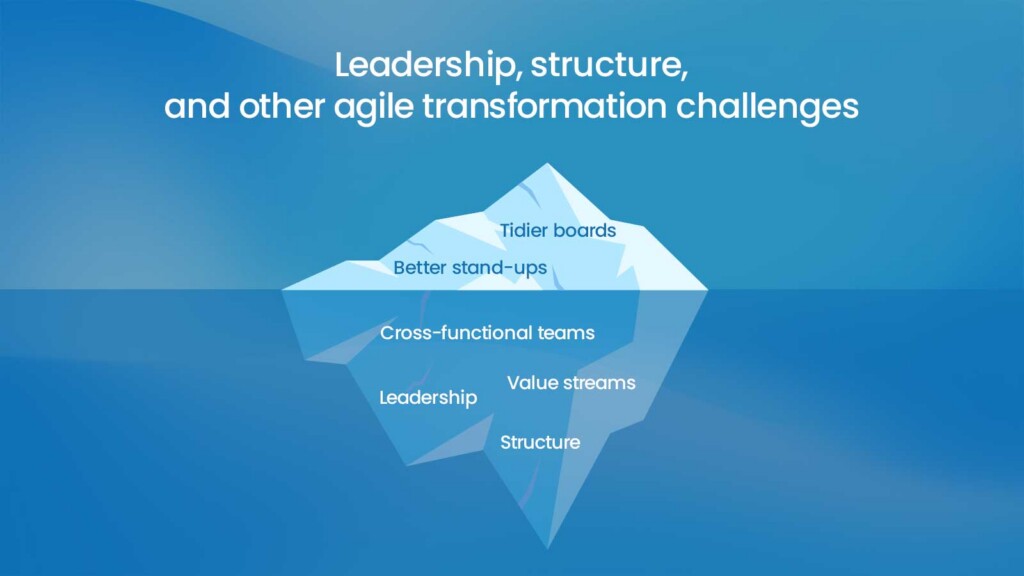
Structure is the second trap. If the org chart, funding model, and team boundaries still mirror the old hand-off-heavy process, no amount of ceremony will produce flow. Real change usually means reorganizing around value streams and durable, cross-functional teams, and managing the dependencies that remain between them — uncomfortable work that organizations often defer indefinitely, which is precisely why their Agile adoption plateaus.
This is why failure of Agile transformations is best understood as a leadership and structure problem wearing a process costume. The teams are usually willing; the system around them is not. Fixing the costume — better stand-ups, tidier boards — while leaving the system intact is the defining mistake.
The lifecycle of failure: deep dive into anti-patterns
To truly navigate these Agile transformation challenges, organizations must recognize that failure modes evolve over time. Year two is typically when the cosmetic veneer cracks and the real problems emerge:
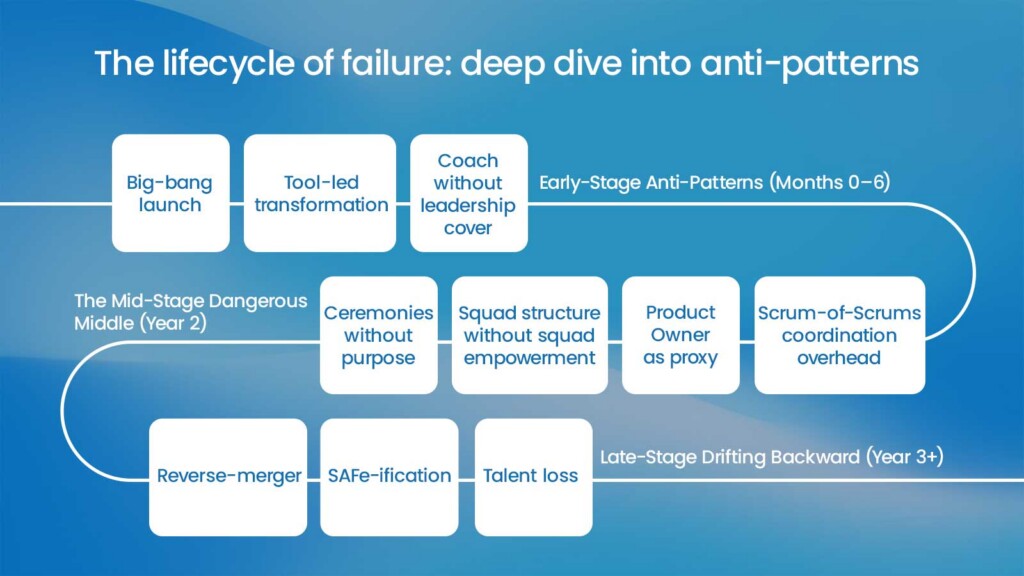
Early-Stage Anti-Patterns (Months 0–6):
- Big-bang launch: All teams go Agile on the same Monday after a single training week. It looks decisive but produces a uniform, shallow transformation that is identically broken across teams. It is always better to pilot first and scale by pattern, not by date.
- Tool-led transformation: Prioritizing Jira configuration over behavior change. The tool merely encodes the old process with new labels, and real behavioral change never arrives.
- Coach without leadership cover: A coach is hired, but leadership doesn’t back the structural changes they recommend. The coach gets ground down within months, and leadership concludes, “We tried Agile, and it didn’t work.”
The Mid-Stage Dangerous Middle (Year 2):
- Ceremonies without purpose: Retrospectives produce no actions, refinements don’t change the backlog, and stand-ups drift into rigid status reports. Ceremonies become empty rituals. They are also held only at team level, which is the one level that cannot fix a problem living between teams.
- Squad structure without squad empowerment: Teams theoretically “own” their product, but every decision must still pass through traditional management layers, resulting in net overhead rather than autonomy.
- Scrum Master without a mandate: the accountability exists on paper but stops at the team boundary. Scrum has the Scrum Master establishing Scrum in the wider organization; where that half of the job is never granted, the impediments that block delivery are the ones nobody is authorized to touch.
- Product Owner as proxy: Product Owners act without actual authority, simply taking top-down direction and passing it to the team. The team loses direct stakeholder access without gaining a real product owner.
- Scrum of Scrums run as a status meeting: Instead of coordinating, it morphs into a mini-PMO that re-creates the central planning the transformation was supposed to remove.
Late-Stage Drifting Backward (Year 3+):
- Reverse-merger: The transformation team is rotated out or reabsorbed into the old organization without building internal capability. Team leads revert to traditional managers, and the structure regresses within 18 months.
- SAFe-ification: Light-touch Agile is replaced by heavy scaling frameworks under the guise of “needing more coordination.” This is often a sign that the underlying architecture and coupled systems were never fixed.
- Talent loss: High-performing engineers who sought a true Agile environment notice the regression and leave, causing a cultural drift back to traditional mindsets.
- The Daily Scrum is the clearest case. Its purpose is an actionable plan for the next day against the Sprint Goal. The Guide dropped the three questions in 2020 because teams were reciting them without re-planning anything, decided the event was pointless, and stopped holding it. A retrospective can fail the same way. If it ends with what went well and what went badly and changes nothing the team does next, it is not the event the Guide describes. Scrum asks for the most impactful improvement to be acted on at once, and to enter the next Sprint Backlog if that is what it takes. The board is a different case. It is not part of Scrum at all, and it earns its place only by making flow visible, above all across teams, where the dependencies behind most bottlenecks live.
Measuring the wrong things
Transformations also fail on metrics. Tracking velocity, utilization, or story-point output rewards busyness and gameable numbers, not value delivered. When story-point velocity becomes a team’s identity, it is quickly optimized, gamed, and used as a stick, saying nothing about whether the team is building the right thing.
When teams are measured on output, they optimize for output — more tickets, fuller sprints — while the outcomes that justified the transformation go unmeasured. Effective programs measure flow and value: lead time, predictability, and whether the work moved a business outcome.
What organizations do differently when it works
Where transformation sticks, leadership treats it as a change to their own behavior first. If the leadership continues to bypass the Product Owner to re-order the backlog, no team-level process matters. They move to flexible funding, framework as outcomes rather than fixed scope, and protect teams’ autonomy to decide how. They reorganize around value streams rather than asking teams to be Agile within an unchanged structure.
They work the level between the team and the boardroom. Most organizations improve teams and leave the dependencies between teams unmanaged, so the local gains never add up to a faster business. What helps is making the flow across teams visible as one value stream, on one board, with someone who has the authority to sequence what crosses it. Without it, the teams improve and the delivery dates stay where they are.
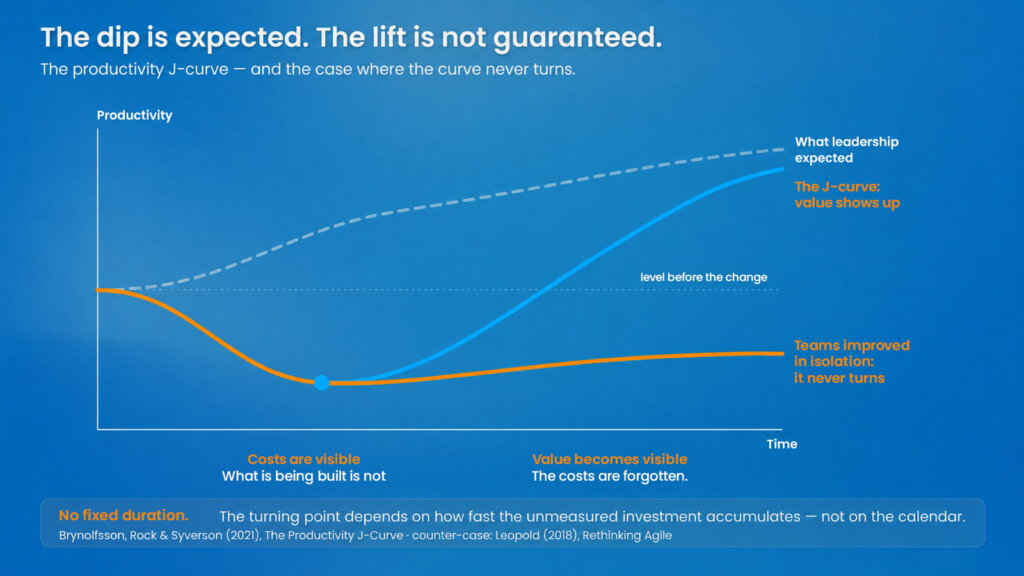
They also show a tolerance for the “dip before lift.” Year two often looks worse on performance charts than year one because teams are finally tackling the hard, systemic work—such as re-architecture, technical debt, and cultural resets. Organizations that pull the plug during this dip never see the ultimate lift.
The pattern has a name and a literature behind it: the productivity J-curve, described by Brynjolfsson, Rock and Syverson for general purpose technologies. The measurable costs of a change land first; the value being built is real but invisible to the numbers until later. It is the same curve organizations are meeting again now with AI, which is why the argument here is not only about Agile.
One caution comes with it: the research puts no fixed duration on the curve. The turning point depends on how fast the unmeasured investment accumulates, not on the calendar. The dip is only worth sitting out if the structural work is real. Where teams are improved in isolation and the dependencies between them are left alone, the curve flattens instead of lifting, and the improvement never arrives. That is the central finding of Klaus Leopold’s Rethinking Agile. It is also why the honesty test below is a better guide than patience.
There is a second reason year two looks worse, and it is the one most people miss. Agility runs on transparency. Making the flow of work visible is what exposes where it gets stuck, and those bottlenecks were always there: the board did not create them, it revealed them. Seeing them hurts, because problems that used to be absorbed now have a name and a place on a wall. That exposure is not a side effect of the method. It is the method. Nothing improves until the bottleneck is the thing being worked on, and the bottleneck sets the throughput of the whole system no matter how hard everything around it works.
Organizations that cannot tolerate the sight of their own problems do one of two things. They stop the transformation, or they make the transparency go away: stop measuring flow, soften the board, drop the retrospective that keeps raising the same thing. The second is the worse outcome, because it leaves the rituals standing and removes the only thing that made them worth doing.
The other consistent ingredient is sustained enablement rather than a one-off rollout. Training kicks things off, but explicit investment in internal coaching capability is what carries new behaviors through the inevitable friction. The format of that training decides how much of it survives contact with the work: a course people sit through produces recall; a course built on exercises and simulation produces capability. External coaches must hand over to named internal people on an explicit timeline; otherwise, the transformation evaporates. Increasingly, this includes helping teams adopt AI tooling responsibly — see how AI-augmented software development changes day-to-day practice — so that improvement compounds. The organizations that succeed treat transformation as continuous capability building, not a program with an end date.
A practical starting point is not a framework. Put the people who own the parts of one value stream in a room and agree the single business problem that matters most: speed, value, or predictability. Turn that into a north star every later change has to serve. Arguments about sequencing, funding and structure get much easier once it exists.
There is also a tempo to getting it right. Successful transformations sequence the change: a few teams prove the new way of working with real outcomes, leadership adjusts funding and structure in response, and the pattern spreads on evidence rather than mandate. The failures tend to do the opposite — a simultaneous, organization-wide rollout of ceremonies imposed from the top, with no structural change underneath and no time for learning to compound. Slower and structural beats fast and cosmetic every time.
The transformation itself has to work the way agile works: iteratively and incrementally. The two words are not the same, and the difference matters. Incremental means the change grows piece by piece: for example, start with a few teams, one practice, one product area, and add from there. Iterative means each step is inspected and the approach is revised before the next one, so the plan learns as it goes. Executing a fixed plan step by step is neither of these. It is a waterfall cut into smaller slices. That is what the company in Leopold’s case study did: an eighteen-month transformation project, with milestones and checklists, to become agile. Sixteen external coaches were hired and six hundred people trained — and at the end of it, projects were delivered more slowly than before the transformation began. The plan was executed. Nothing was learned along the way, so nothing improved. The irony is Leopold’s own point.
The structural honesty test
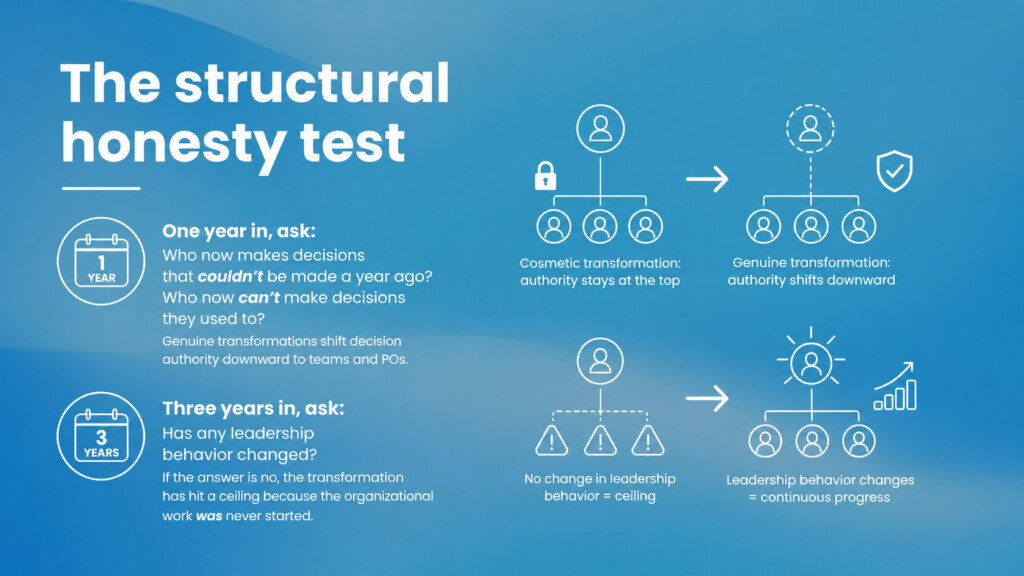
To measure genuine progress, organizations should apply a simple test at key milestones:
- One year in, ask: Who now makes decisions that couldn’t be made a year ago? Who now can’t make decisions they used to? Genuine transformations shift decision authority downward to teams and Product Owners. Cosmetic ones shift titles without shifting authority.
- Three years in, ask: Has any leadership behavior changed? If the answer is no, the transformation has hit a ceiling because the organizational work was never started.
A realistic alternative: sustained partial transformation
While complete, organization-wide transformations are ideal, they are exceedingly rare. A highly realistic and successful outcome is a sustained partial transformation. In this state, specific product areas operate with high Agile maturity, while the rest of the organization continues to operate traditionally through clearly defined interfaces.
This is not a failure — it is often the optimal end state. Forcing a full transformation across parts of a business where it does not fit can cost more than the benefit it provides. Committing to a partial transformation honestly allows for stability, whereas pretending to aim for full transformation leaves excluded teams feeling demoralized and left behind.
The human cost of a failed transformation
Beyond wasted budget, a failed transformation leaves a residue that makes the next attempt harder. Teams that were promised more autonomy and got more meetings grow cynical; “Agile” becomes a word people roll their eyes at. The engineers who joined for an Agile environment notice this stagnation and leave, while replacement talent arrives with lower expectations.
This cynicism is itself a major Agile transformation challenge, because the second attempt must overcome not just the original obstacles but the scar tissue from the first. Naming this honestly — rather than rebranding the same theater under a new framework — is part of recovering credibility.

The way out is to demonstrate real change quickly and visibly: give one team genuine end-to-end ownership of an outcome, remove a concrete impediment that everyone knows about, and let the result speak. Small, real wins rebuild the trust that abstract programs erode. Agile adoption sticks when people see their own working life improve, not when they are told a transformation is underway.
Seen this way, the antidote to why Agile transformations fail is not more rigor in the ceremonies but more courage in the structure: changing how money flows, how teams are shaped, and how success is measured.
Choosing help: what to ask Agile consulting companies
Outside help can accelerate change or entrench theater, depending on who you choose. The Agile consulting companies worth engaging will insist on working with leadership, not just teams, because they know that is where transformations are won or lost. Be cautious of partners who deliver training and certifications and leave, or who measure their own success by activity rather than your outcomes.
Ask any prospective partner how they handle leadership, structure, and metrics — the three places transformations actually fail — and how they build internal capability, so you are not dependent on them indefinitely. Axon Active approaches this as enablement: coaching that develops your own people and leaders, with a clear handover, so the change outlives the engagement. That orientation — capability over dependency — is the most reliable predictor of whether a transformation will hold.
A good partner will be able to tell you, candidly, why Agile transformations fail in organizations like yours specifically — and will be more interested in your funding model and org structure than in your sprint cadence. If the conversation never leaves the team level, you are buying theater, not change.
Conclusion
An Agile transformation is never just a shift in software engineering or project management — it is a fundamental restructuring of how an organization operates, thinks, and funds its value. The reason why Agile transformations fail so frequently is not that teams lack the discipline to stand up or update a board; it is because the corporate ecosystem around them continues to demand legacy predictability in a non-linear world.
To overcome these Agile transformation challenges, leadership must have the courage to step out of the “theater” and look honestly at their organizational structure, decision authority, and funding models. Real agility is slower to build, and it often feels uncomfortable during the year-two dip, but it is the only way to build a resilient, continuous capability that adapts to change.
FAQs
Why do Agile transformations fail so often?
Agile transformations fail most often because organizations adopt the ceremonies without changing how decisions, funding, and structure actually work — what is known as Agile theater. The framework is rarely the problem; unchanged leadership behavior, hand-off-heavy structures, and output-based metrics are. Where those change, transformations tend to stick.
What are the biggest Agile transformation challenges?
The biggest challenges sit above the team: leadership that delegates the change instead of changing its own behavior, organizational structures and funding models that still reward the old way, and metrics that measure output rather than flow and outcomes. Addressing these is harder than running ceremonies, which is why so many efforts stall.
How can an organization make Agile adoption stick?
Sustained Agile adoption comes from leadership changing how it funds and steers work, reorganizing around value streams, measuring flow and outcomes instead of utilization, and investing in ongoing coaching rather than one-off training. Treating it as continuous capability building — not a time-boxed program — is what makes the change durable.
Ready to transform without the theater?
Don’t let your transformation become another case of cosmetic compliance and wasted budget. Whether you are navigating your first Agile adoption or looking to heal the scar tissue of a previous failed attempt, you need a partner who focuses on long-term enablement rather than short-term certifications.
Let us help you build the internal capability your organization needs to thrive independently.