

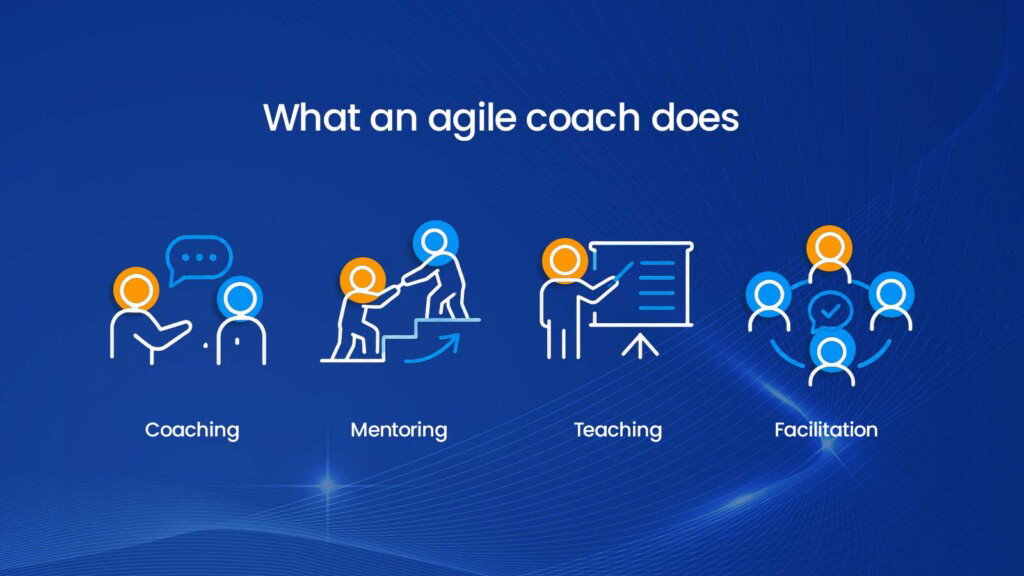
What an Agile coach does
What is an Agile coach? The work itself is ordinary enough. A coach uses coaching, mentoring, teaching, and facilitation — the four modalities Lyssa Adkins and Michael Spayd set out in the Agile Coaching Competency Framework — depending on what the situation needs. On a given day that might mean coaching a team lead through a difficult prioritization decision, facilitating a retrospective that finally names the real impediment, or mentoring a Scrum Master who is stuck. The throughline is capability building: the coach’s success is measured by the team’s growing ability to improve itself, not by the coach’s own indispensability.
The thing being changed is the system, not the people in it. Coaching is not about fixing individuals, which is why it reaches beyond the events a team runs. Many Agile efforts stall because the surrounding structure — funding cycles, handoffs, incentives — still rewards the old way of working. An effective coach makes those constraints visible and helps leadership change them, which is where the leverage is.
To make the role concrete, picture the stance a coach adopts. Sometimes they are directive — teaching a practice the team has never seen. More often they are non-directive — asking the questions that lead a team to its own insight, because solutions people reach themselves are the ones they keep. Skilled coaches move fluidly between these stances and know which the moment calls for a continuum professional coaching has described since Carl Rogers and which Myles Downey set out as a spectrum from non-directive to directive. That judgment, built over many engagements, is what separates an experienced Agile coach from someone who has simply memorized a framework. A coaching question is open, carries no answer hidden inside it, and leaves the thinking with the team: What is really slowing you down here? Whose decision is this — and whose should it be? What would have to be true for you to no longer need a coach?
o when people ask what is an Agile coach in practical terms, the cleanest answer is this: someone who asks the questions that change the system around your teams and leaders, so they get better at improving themselves — and then leaves. Everything that follows is an elaboration of that single idea.
Coach vs Scrum Master vs trainer vs facilitator: who is accountable for what?
These four roles overlap in what they do. They differ in what they are accountable for, and that is the more useful distinction. On activity alone they are hard to tell apart: the Scrum Guide already has the Scrum Master coaching, teaching and facilitating, and Axon’s own training material describes a Scrum Master as trainer, facilitator, consultant, coach and change agent. Scrum supplies the better axis itself: a role is not a title but an accountability, a description of the service that role is expected to provide.
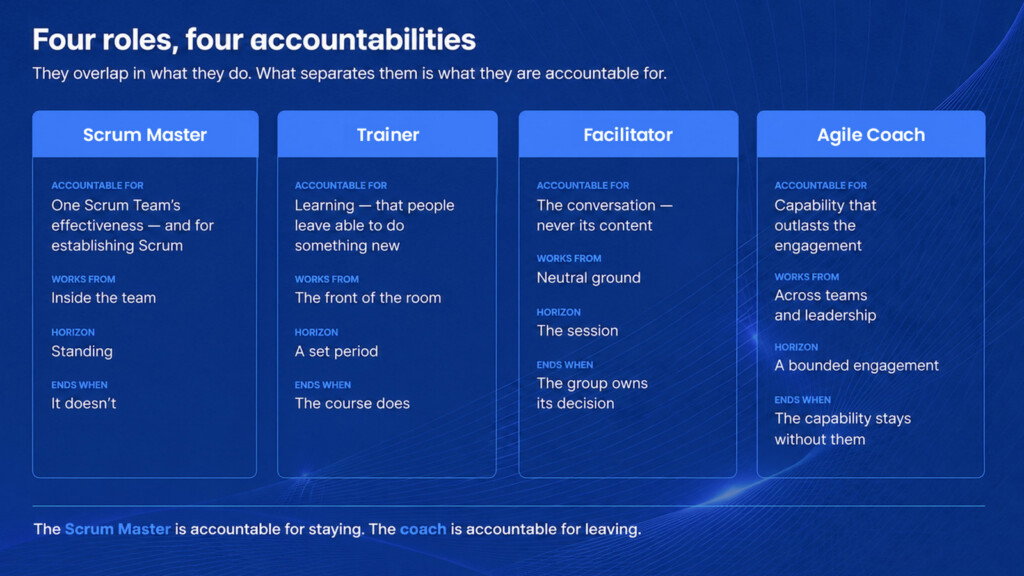
A Scrum Master is accountable for the Scrum Team’s effectiveness and for establishing Scrum around it. It is a standing accountability, held from inside, and it does not end.
A trainer is accountable for learning: that people leave able to do something they could not do before. Ask what is agile training, and this is the answer: a defined transfer of concepts and practices over a set period, and an accountability that ends when the course does.
A facilitator is accountable for the conversation and never for its content. The job is to bring a group to a decision it owns, while holding no stake in which decision that turns out to be. Neutrality is the whole job — and it is the part most often lost, because in practice the role lands on whoever called the meeting: the manager, the lead, the person with the strongest opinion about the outcome. That is exactly who cannot hold it. When a decision matters, hand the conversation to someone with nothing at stake.
An agile coach is accountable for capability that outlasts the engagement: across teams and leadership, and with no delivery accountability whatsoever.
That last line answers the obvious question: if the Scrum Master already coaches, why bring in a coach at all? A Scrum Master coaches from inside, with a team to deliver with and a stake in the outcome. A coach has no team, no delivery date and no stake in any particular decision. That is what makes it possible to work on the system that produced the problem, including the leadership layer a Scrum Master rarely reaches. The Scrum Master is accountable for staying. The coach is accountable for leaving.
certified agile coach may hold credentials from any of several bodies — Scrum Alliance (CTC, CEC, and CAF for facilitation), ICAgile (ICP-ACC, ICE-AC, ICP-ATF) or Scrum Inc. (Registered Agile Coach™) — and a certificate is a floor rather than a finish line: in practice the value comes from experience helping real organizations change.
The more useful question is not which certificate someone holds, but how they learned it. Training where one person talks and the room listens produces recall. Training built on exercises, simulation and doing the work produces capability: the difference between knowing a framework and being able to run one. That is why the Fit for course series is built on Training from the Back of the Room and its 4C structure: connections, concepts, concrete practice, conclusions, with exercises rather than slides. It is also why the Agile Fluency® Game and Lean Startup simulations exist at all. The Agile Fluency® Game, for example, is an interactive simulation of a software team’s first two and a half years of adopting agile practices — ten seasons of choices and trade-offs, experienced in a session rather than described. Playing Lean does the same for innovation. Teams run competing startups and choose, round by round, between another customer experiment and building more product: the build-measure-learn trade-off, made in ninety minutes with play money instead of a real budget.
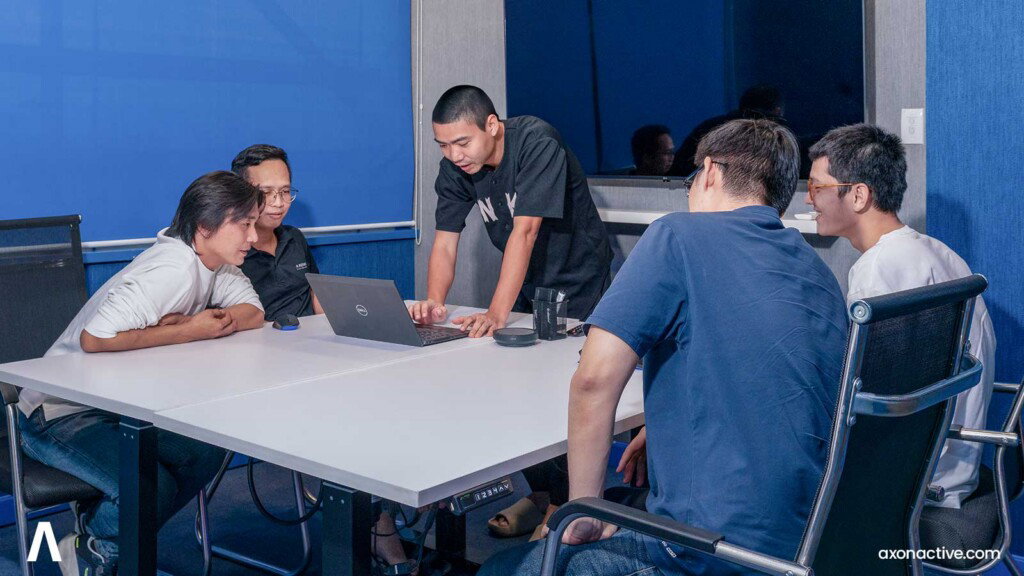
Confusion between these roles is itself a clue to what is an Agile coach: the role exists precisely because training and scrum mastery, valuable as they are, do not by themselves change how an organization makes decisions. The coach occupies the space between them and the leadership above them.
Team coaching vs the Agile enterprise coach
Coaching operates at different altitudes. The Flight Levels model names three of them: the team, the coordination between teams, and strategy. Team-level coaching helps a delivery team mature its practices, improve flow, and build the habit of continuous improvement. It is concrete, close to the work, and shows results in weeks. This is often where organizations start, and where what is Agile training most naturally complements coaching — training builds the baseline; coaching embeds it in real conditions.
An Agile enterprise coach works at a higher altitude: aligning multiple teams, coaching senior leaders, reshaping portfolio and funding models, and connecting delivery to strategy. Enterprise coaching is where transformations succeed or fail, because the obstacles at scale are organizational, not technical. The same person rarely excels at both altitudes, which is why mature Agile consulting companies field coaches with distinct team-level and enterprise-level strengths.
What good coaching delivers
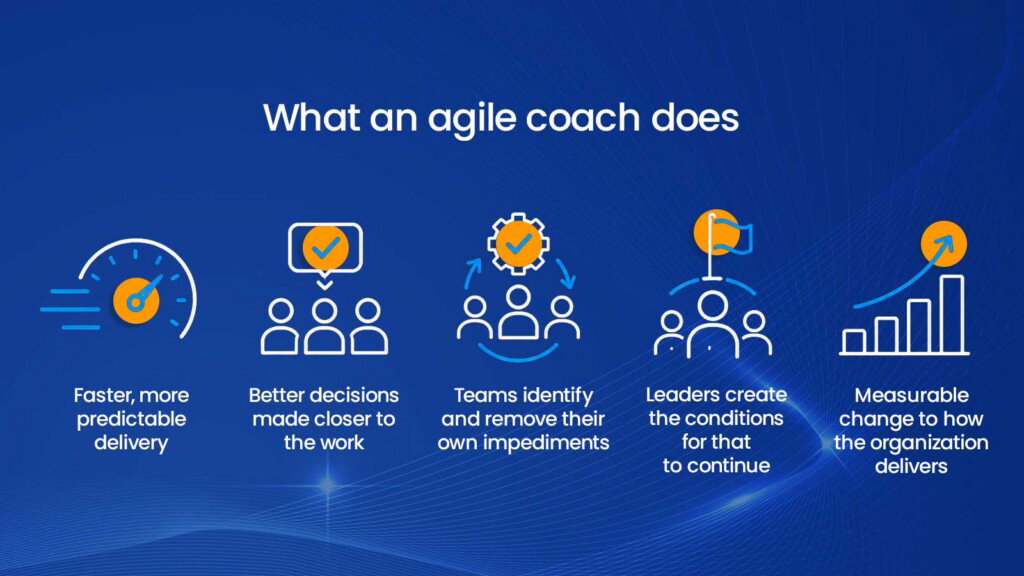
The value of a coach is not in tidier stand-ups; it is in measurable change to how the organization delivers. Expect faster, more predictable delivery; better decisions made closer to the work; teams that identify and remove their own impediments; and leaders who create the conditions for that to continue. A coach who only polishes events is underused; one who shifts how decisions and trade-offs are made is doing the real job.
When evaluating Agile consulting companies, look past certifications to track record: have their coaches helped organizations like yours actually change, and can they point to outcomes rather than activity? Axon Active approaches coaching as enablement — building lasting internal capability and, increasingly, helping teams adopt AI tooling responsibly as part of how they work, rather than creating dependence on outside consultants.
Watch, too, for the anti-patterns. A coach who becomes a permanent fixture, a coach who runs the events the team should own, or a coach whose impact cannot be tied to any change in outcomes — each signals an engagement drifting from its purpose. The discipline of good coaching is to keep transferring ownership back to the organization, and to be measured on the capability left behind.
How to engage a coach well
The mechanics of engagement matter as much as the choice to engage. Start with a clear problem statement — unpredictable delivery, a stalled scaling effort, or leaders unsure how to lead differently — rather than a vague wish to “be more Agile.” Agree what success looks like and how you will know, set a time box, and define the handover from the outset. The best arrangements pair an external coach with internal people who are growing into the role, so capability stays after the coach leaves.
Be deliberate about altitude, too. If your problem is team-level flow, a team coach embedded with delivery teams is the right fit; if it is organizational (funding, structure, leadership behavior) you need enterprise-level coaching that can sit credibly with executives. Mismatching altitude is a common reason engagements underperform: a brilliant team coach cannot fix a portfolio-level problem, and an enterprise coach parachuting into daily stand-ups is an expensive misuse.
Get those mechanics right and the question shifts from what is an Agile coach to what is an Agile coach worth — and for organizations stuck between knowing the practices and benefiting from them, the answer is usually: a great deal.
When should you engage an Agile coach?
Engaging a coach makes sense at specific moments: when teams have completed training but practices are not sticking; when delivery is unpredictable despite “doing Agile”; when a transformation is stalling at the leadership layer; or when scaling beyond a few teams has exposed organizational impediments that no single team can fix. In each case, the trigger is the gap between knowing the practices and consistently benefiting from them.

Engagements are usually time-boxed with an explicit handover: the coach builds internal capability — often growing your own people into the role — and steps back. Be wary of arrangements with no exit; the point of coaching is durable change you own, not a permanent dependency. If your teams are already strong and improving on their own, you may not need one at all.
Agile Coaching at Axon Active
So what coaching looks like here. At Axon Active, it means working across roles (Scrum Masters, Product Owners, Squad Leaders, Agile Tech Leads), teams, and organization-wide transformation.
For multi-team scaling, Axon Active works from its own Axon Model™, which is built on Scrum@Scale. SAFe and LeSS are covered where a client already works that way. Each scales something different: LeSS scales one product, SAFe scales delivery in a structure that runs alongside the existing organization, and Scrum@Scale scales the organization itself. That is the reason for the choice, and it is the same reason coaching works on the system rather than the single team. Behind it are 80+ distributed teams working with clients worldwide, most of them in European time zones.
The training catalog sits alongside it: Fit for Scrum, Fit for Kanban, Fit for XP, Fit for Design Thinking and Fit for Agile Leadership, plus Agile Fluency® and Lean Startup simulations, and the Scrum Alliance certification pathway (CSM, CSPO, CSP-SM, CSP-PO) — making Axon Active the only Vietnam provider offering both simulations.
Frequently Asked Questions
What is an Agile coach in simple terms?
An Agile coach is an experienced practitioner who helps teams and organizations get genuinely good at Agile ways of working — through coaching, mentoring, teaching, and facilitation. Unlike a Scrum Master, who is accountable for the Scrum Team and stays, a coach works across teams and leadership to change how people decide and collaborate, with the aim of building lasting internal capability.
What is the difference between an Agile coach and a Scrum Master?
A Scrum Master is accountable for the Scrum Team’s effectiveness and for establishing Scrum — a standing accountability held from inside the team. An Agile coach carries no delivery accountability at all, works across teams and leadership for a bounded engagement, and is accountable for the capability left behind. Both of them coach; the difference is that the coach’s engagement is meant to end. Neither should be confused with a facilitator, who is accountable for the quality of a conversation and never for its content, nor with a trainer, whose accountability ends with the course.
When should an enterprise engage an Agile coach?
Engage a coach when teams have been trained but practices are not sticking, when delivery stays unpredictable despite adopting Agile, or when a transformation stalls at the leadership or scaling layer. The right engagement is time-boxed and builds internal capability, leaving you less dependent on outside help, not more.